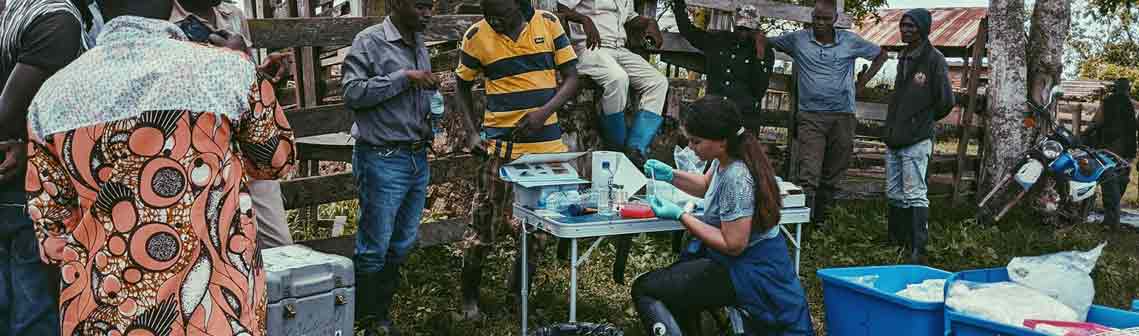
This CIH course component is an introduction to concepts and methods to analyse health problems, interventions and health programmes. This analysis helps to understand the importance of the problem, its burden and its determinants. The theoretical aspects of four main intervention strategies: vector control; screen, test and treat; vaccination strategies; and behavioural interventions, are discussed whether applied as a preventive, curative or rehabilitative concept. Some current operational challenges in the prevention and control of key health problems are touched upon. Concepts taught in the first two weeks will be applied in the context of an outbreak, both in outbreak investigation and outbreak mitigation.
The concepts, analytical frameworks, and implementation strategies are illustrated through applications in a wide range of health problems: malaria, measles, syphilis, mpox, COPD, pulmonary tuberculosis, cholera, and schistosomiasis. The focus is on low- and middle-income countries, but also other contexts of high-income countries are included.
The overall goal of the course "Health Problems: From Prevention to Control" is to empower students with a comprehensive understanding of health challenges and equip them with the knowledge, skills, and ethical awareness needed to make meaningful contributions to the prevention, management, and control of health problems, thereby promoting individual and community well-being.
By the end of course component 1 (CC1), you are expected to have a comprehensive understanding of various health issues and get the knowledge and skills to effectively prevent, plan interventions, and control them.
You should specifically be able to:
1: To realize a health problem analysis
At the end of this sub-component, the participant should be able to:
· Describe the importance/burden of a particular health problem in terms of frequency, severity, inequity and economic cost and compare it with the importance of other health problems
· Determine different stages of health problem/disease evolution, their risk factors and (social) determinants, and the transmission modes (for communicable diseases)
2: To understand the main public health interventions to prevent and/or control a health problem
At the end of this sub-component, the participant should be able to:
· Explain the link between epidemiological model, risk factors and intervention approaches
· Identify and appraise theoretically possible intervention strategies - ranging from health promotion, disease prevention and control, and curative care – that can reduce the burden at individual and/or population level caused by a particular health problem
· Describe the four main public health intervention strategies in terms of effectiveness: vector control, vaccination, screen, test & treat, and behavioural change strategies
· Recognise and appraise the importance of implementation challenges in the prevention and control of key health problems, such as acceptability, identification of target groups, community and patient involvement
3: To a) identify and investigate an outbreak of an infectious disease in a vulnerable context and b) review response and preparedness activities for outbreaks and pandemics
At the end of this sub-component, the participant should be able to:
· Detect an outbreak, based on epidemiological data
· Identify steps of an outbreak investigation
· Describe an outbreak in terms of time, place, person
· Communicate findings of an outbreak investigation
· Understand how identification and application of lessons learned from previous outbreaks can aid future prevention and control strategies
· Identify and categorize challenges and successes of a pandemic response, and understand how these can guide pandemic preparedness
4: Generic competencies:
· Search for information in relevant sources
· Critically assess data and findings in literature and other sources
· Interpret, summarise and present information orally
· Work effectively in diverse, multidisciplinary teams